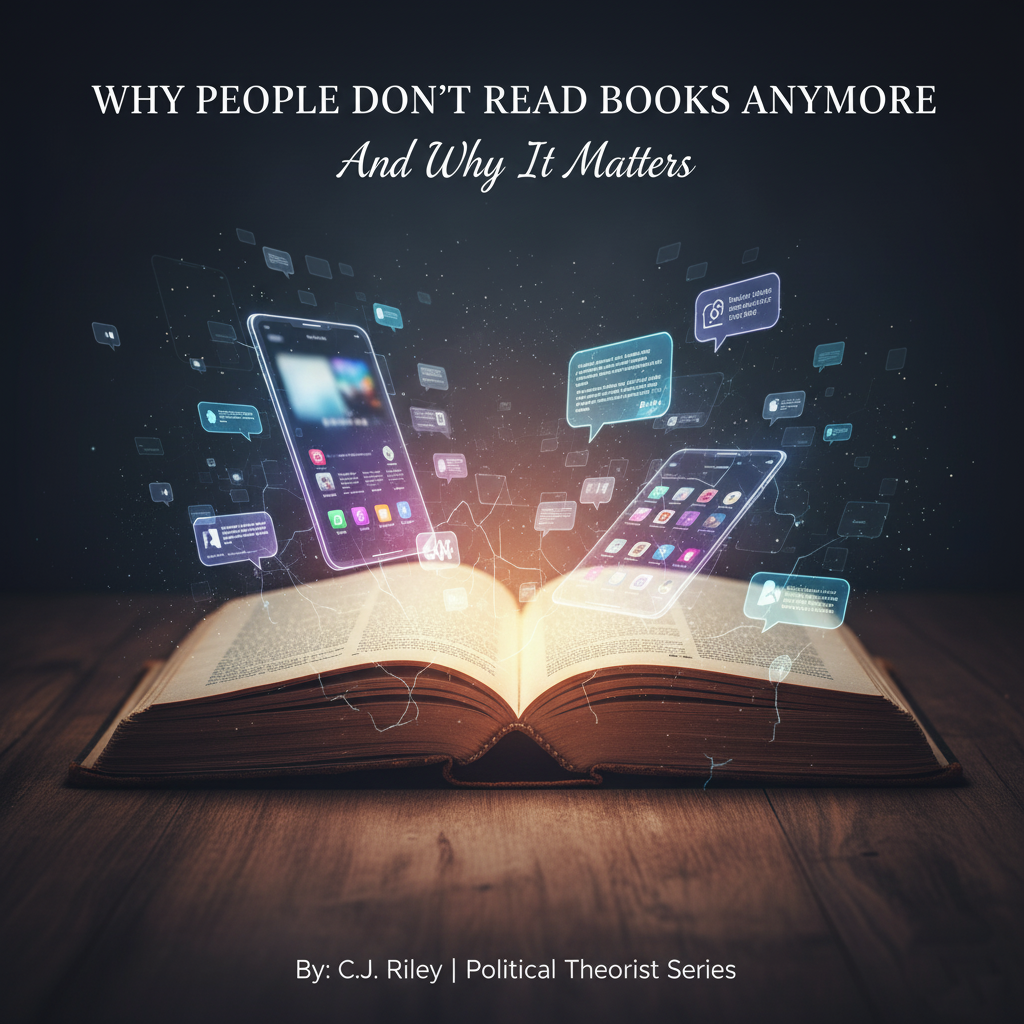

Pip: C.J. Riley opens with a question that feels almost embarrassing to ask out loud: did we just collectively forget how to read?
Mara: This episode sits with that question — what’s pulling us away from books, and what we lose when attention becomes the scarcest resource we have.
Pip: Let’s start with the attention economy and what it’s quietly doing to the way we think.
Why We Stopped Reading — And What It’s Costing Us
Mara: The post opens with a blunt observation: the problem isn’t that people stopped caring about ideas, it’s that the way we process information has fundamentally changed — and books are casualties of that shift.
Pip: The post reaches back to Neil Postman to put a name on the mechanism. The setup is that Postman saw this coming long before smartphones existed, and the argument lands hard: “television, and now its digital descendants, doesn’t destroy intelligence, it replaces context with entertainment.”
Mara: So the upshot is that screens don’t make us dumber — they redirect the effort. Reading asks you to build the picture yourself; the screen builds it for you. That’s a different cognitive workout entirely.
Pip: And the economy has organized itself around making sure the screen always wins that competition.
Mara: Sociologist Sherry Turkle’s framing gets a mention here — the “flight from conversation,” where constant connection produces a kind of meaning-shaped hole. We’re surrounded by words, but not by depth.
Pip: A book doesn’t refresh. It doesn’t notify. In 2025, that’s practically a design flaw.
Mara: The piece connects this to political life directly. Hannah Arendt’s line about thinking requiring “a dialogue between me and myself” is the hinge — books sustain that inner dialogue, and scrolling silences it. The consequence the post draws is concrete: when attention fragments, reasoning goes reactive instead of reflective, and slogans fill the space that arguments used to occupy.
Pip: Which is a polite way of describing most comment sections.
Mara: Education gets a turn here too. The post notes that schools have shifted toward comprehension as a skill — extracting key points — rather than reading as an experience. When it becomes an assignment rather than an adventure, the post argues, it loses its pull on young readers entirely.
Mara: The closing note is genuinely hopeful: finishing a book is framed as a small act of resistance — proof that the slow mind still has power to think, to empathize, and to stay human.
Pip: And if that’s where we are — where reading a novel counts as rebellion — the stakes for what comes next feel pretty clear.
Mara: The thread running through all of this is attention — what we do with it, and what we lose when it gets parceled out in fragments.
Pip: Next time, we’ll see what else C.J. Riley is turning that brilliant mind toward.
Leave a Reply