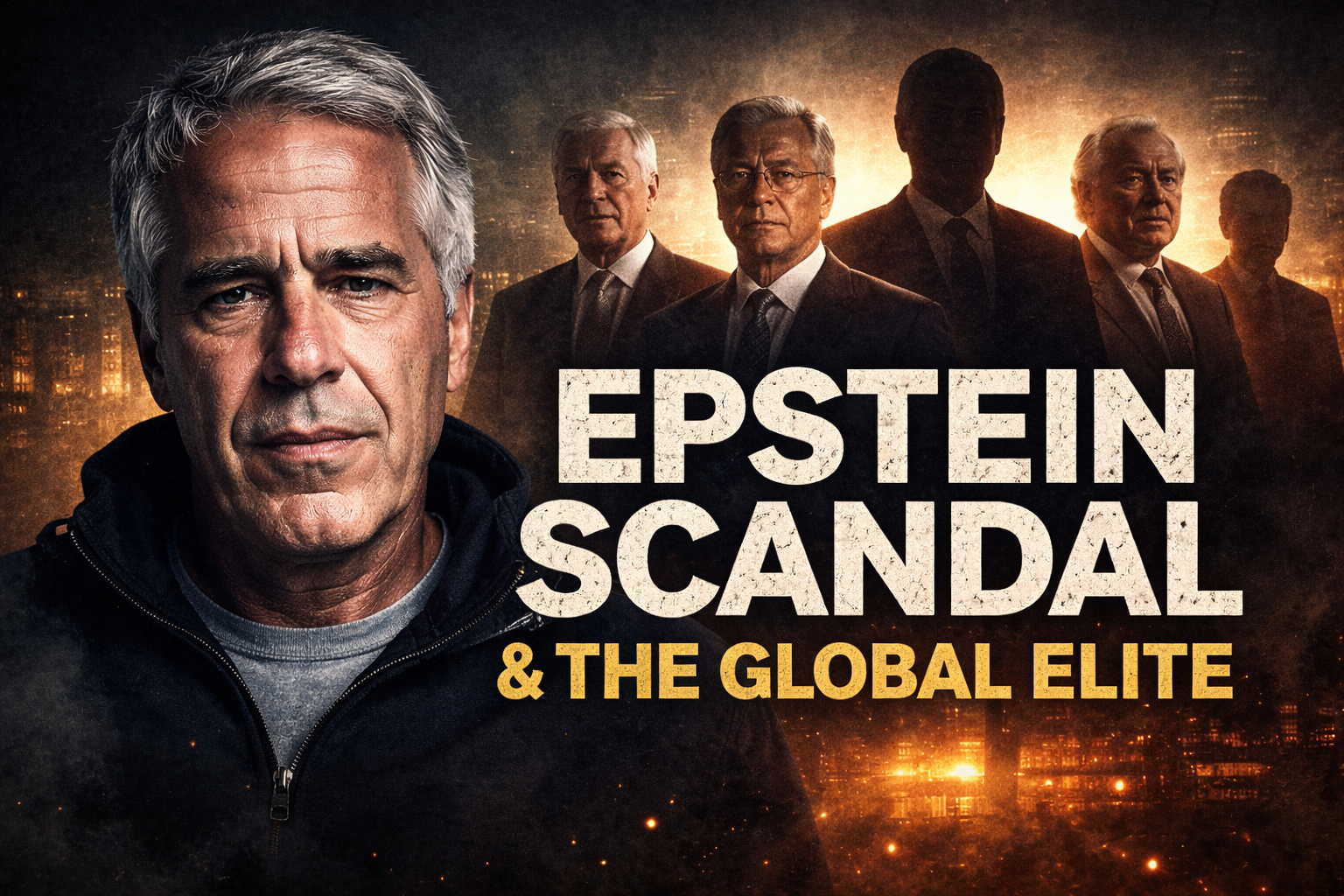

By: C.J. Riley | A Political Theorist Series
Scandals do not destroy nations. What destroys them is the slow realization that rules apply differently depending on who you are.
The renewed attention on Jeffrey Epstein’s network has not ignited public fury because of prurience. It has unsettled people because it reinforces a belief long forming beneath the surface of modern democracies: that the powerful live behind a moral firewall ordinary citizens cannot breach.
This is not primarily a story about crimes… Epstein’s guilt was established. It is a story about association, access, and immunity, and what happens to public trust when elite proximity to corruption appears consequence-free.
Association Is Not Guilt-but It Is Not Nothing
A healthy society distinguishes between evidence and rumor. But it also understands that repeated proximity to wrongdoing demands explanation, not dismissal.
Several figures whose associations with Epstein are documented and uncontested, though not criminally proven, have faced lasting reputational damage:
- Prince Andrew: His association with Epstein led to a civil settlement with Virginia Giuffre in 2022 and the effective end of his public role. When the Epstein files were released, pictures of questionable actions and positions were proven. The British monarchy stripped him of military titles and royal patronages amid overwhelming public backlash.
- Bill Clinton: Flight logs confirm multiple trips on Epstein’s plane. Pictures of Bill Clinton interacting with questionable actions. Clinton has denied any knowledge of criminal activity, but the revelations fueled renewed criticism and forced repeated public distancing statements from Democratic institutions already facing credibility strain. As of now, there are conversations of the Clintons acting as witnesses to avoid jail time.
- Les Wexner: The billionaire retail magnate acknowledged Epstein’s role as his financial manager and later described him as having “misappropriated” funds. Wexner resigned from major philanthropic boards as public pressure mounted.
- Alan Dershowitz: Though denying all allegations and not charged, Dershowitz’s involvement led to lawsuits, countersuits, and years of public controversy that permanently altered his standing.
- Bill Gates: Bill Gates acknowledged multiple meetings with Epstein after Epstein’s 2008 conviction, framing them as misguided efforts tied to philanthropy and funding discussions. While Gates has denied any knowledge of or involvement in criminal activity, the relationship proved reputationally catastrophic. Melinda French Gates commented on the issue, almost confirming the contrary to Bill Gates’ denial. These issues were a major contributing factor to his resignation from the Gates Foundation board, prompting public distancing from institutions that once treated him as a moral authority.
- Rothschild Family (Nathaniel Rothschild): Epstein’s documented social association with British financier Nathaniel Rothschild, used by Epstein to signal elite legitimacy, has ensured the family’s name lingers in the scandal’s orbit. The episode underscores a harsher modern reality: in an era of elite impunity, proximity to power is enough to invite suspicion, and silence is often mistaken for insulation rather than innocence.
These are not internet theories. These are documented associations followed by measurable institutional fallout.
The public reaction has been consistent: not yet mob rage, but a withdrawal of trust and anger for betrayal.
Why the Economy Notices Moral Failure
Markets depend on confidence, not virtue, but they require predictability. When citizens believe elites operate by different rules, uncertainty creeps into everything from investment to governance.
This is not hypothetical. After the Panama Papers, global markets experienced measurable volatility as investors recalibrated political risk. After the 2008 financial crisis, public trust in institutions collapsed, not because banks failed, but because accountability did not follow.
The elite scandal acts as a tax on confidence. Capital hesitates. Institutions retreat. People disengage.
An economy can survive corruption.
It cannot thrive amid perceived impunity.
Foreign Policy and the Danger of Insulation
The Epstein affair also exposes something subtler and more dangerous: elite detachment.
In the years preceding the war in Ukraine, policymakers, financiers, and global institutions increasingly spoke of conflict as profitable, often in closed forums far removed from those who would bear the cost.
This was not just a conspiracy; it was an illusion to hide the inevitable berating if caught planning a war with Russian Communist Dictator Vladimir Putin.
History shows that when leaders are buffered from consequence, war becomes inevitable. Human suffering becomes abstract. Moral gravity weakens.
The same insulation that shields elites from accountability in scandal can shield them from restraint in statecraft.
The Public Is Not Radicalized… It Is Disillusioned
Contrary to media shorthand, the public response has not been hysterical. It has been something more corrosive: disbelief. However, as Information is released, the people’s anger is increasingly evident.
People disengage when they conclude:
Justice is selective
Transparency is conditional
Accountability is negotiable
This disengagement fuels extremism on the margins and apathy in the center, both of which are fatal to democratic stability.
Political decay rarely begins with violence. It begins with resignation.
An Old Lesson, Relearned the Hard Way
Every republic that failed believed its elites were indispensable. Everyone fell when citizens decided they were untouchable.
The Epstein scandal is not only dangerous because of what it proves, but also because of what it confirms in the public imagination: that power protects itself first.
A society can survive hypocrisy.
It cannot survive the belief that hypocrisy is permanent.
Final Thought
This is not a call for vengeance or spectacle. It is a call for concentration.
If the law does not stand above power, power will eventually stand alone.
When belief and morality collapse, no institution, political or economic, remains stable for long.
History does not punish nations for scandal.
It punishes them for tolerating it.


Leave a Reply to C.J. RileyCancel reply