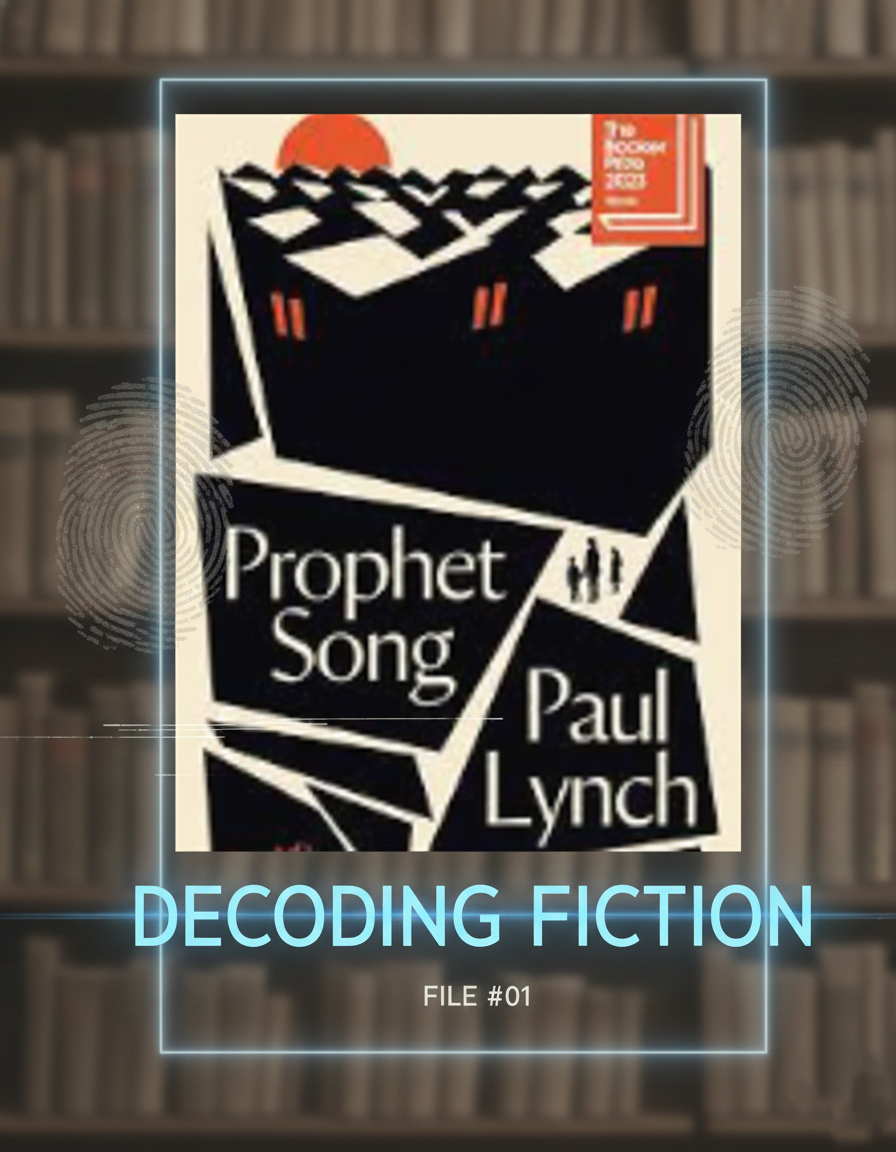

Decoding Fiction – File #01: Prophet Song by Paul Lynch
There’s a difference between a dystopia imagined and a dystopia remembered. Paul Lynch’s Prophet Song belongs to the second category. It doesn’t warn us of some abstract future; it makes us recall something we’ve already seen but pretended was fiction.
The Near-Future Unraveling
The novel takes place in a near-future Ireland where the trappings of democracy collapse almost imperceptibly. Emergency powers are enacted, police authority expands, and citizens disappear. What begins as a bureaucratic inconvenience—a father detained without explanation—unfolds into an intimate portrait of societal decay. The story follows Eilish Stack, a mother of four, whose home life becomes the measure of a nation’s unraveling.
The Style of Suffocation
Lynch’s prose doesn’t shout. It whispers, it presses, it seeps under the skin. His style is streamlike and relentless, often unbroken by paragraphs, mirroring the suffocating continuity of fear. The technique works because it denies us the comfort of distance. We don’t get to rest between sentences any more than Eilish gets to rest between crises.
There’s an eerie precision in how Lynch portrays the slow erosion of freedom. He understands that authoritarianism rarely arrives dressed as tyranny. It shows up with polite manners and procedural language, always insisting it’s only temporary. It’s in the form you sign without reading. It’s in the new law that isn’t meant for you—until it is.
Emotional Proximity Over Political Statement
What makes Prophet Song remarkable isn’t its premise but its emotional proximity. Lynch doesn’t use grand political statements. He uses small, human details: a mother’s fatigue, a child’s question, the emptiness of a room once filled with safety. The tension isn’t built through action, but through erosion—the feeling that everything solid is slowly, inexorably being washed away.
In another writer’s hands, this might have become a parable or allegory. In Lynch’s, it feels like reportage. His Ireland is not metaphorical—it’s plausible, perhaps inevitable. When Eilish clings to the illusion that normal life can continue, readers recognize the same quiet denial that runs through every society on the verge of losing itself.
The Uncomfortable Current
If the book falters, it’s in the weight of its own intensity. Lynch’s long, breathless sentences can overwhelm, leaving little room for reflection. But then, maybe that’s the point. The novel traps us in the same claustrophobic current that consumes its characters. It refuses catharsis. There are no heroes here, only survivors who, too late, understand what was lost.
Reading Prophet Song feels like standing in still water and realizing the tide is pulling you out to sea. It’s not a warning about the future—it’s a reminder of how quietly the present can disappear.
In the end, Lynch doesn’t prophesy. He observes. And what he observes is us.

Leave a Reply